17 August 2012

08 August 2012


14 July 2012
Food for Thought for Food

Salmon Evolve to Cope with Climate Change
Try this on for size (from Scientific) America
Global warming is beginning to drive the timing of salmon migrations
Pink salmon populations in Alaska have evolved to migrate earlier in the season, reacting

Fluctuations in water temperature can adversely affect fish populations, leading to an increased risk of disease and mortality. When streamwater began to warm faster than normal, pink salmon populations took the hint, leaving their freshwater homes earlier than usual.
Now, migration occurs nearly two weeks sooner than it did 40 years ago, according to a study sponsored by the University of Alaska, Fairbanks, and University of Alaska Southeast. The rapid adaptation is a sign that larger organisms can cope with climate change, said David Tallmon, an associate professor of biology and marine biology at UAS and author of the paper.
"It demonstrates evolutionary change in response to warming temperatures," he said. "It provides some hope for species to adapt to changing climate."
The study, published in the Proceedings of the Royal Society B, looked at pink salmon populations in Auke Creek, analyzing 32 years of genetic data beginning in the 1970s. Scientists examined 17 generations of the salmon, and they sampled five to 30 fish every day during the odd years from 1983 to 1993, plus 2001 and 2011. Their findings show a 20 percent reduction in late-migrating fish, which made up only about 10 percent of the sampled population as of last year.
The switch toward an earlier migration pattern was exceptionally apparent between 1989 and 1993. Stream temperatures during peak migration in 1989 were the second highest on record. From then on, scientists observed substantial genetic changes in the offspring from that spawning generation, the study says.
But evolution isn't always a good thing, because genetic shifts are a give-and-take process. When an organism adopts one positive attribute, another is weakened, potentially reducing the overall fitness of the organism.
An evolutionary impact
Changes in genetic makeup also come at a cost in terms of biocomplexity. The Auke Creek late-migrating salmon populations have all but disappeared in favor of early-migrating salmon. This significantly reduces the genetic variability in the population and would make it difficult for salmon to cope should temperatures reverse.
Changes in genetic makeup also come at a cost in terms of biocomplexity. The Auke Creek late-migrating salmon populations have all but disappeared in favor of early-migrating salmon. This significantly reduces the genetic variability in the population and would make it difficult for salmon to cope should temperatures reverse.
Pink salmon have adapted so far, Tallmon said, but no one can predict the extent to which they can stretch. It is possible that they will not continue to evolve in the coming decades.
"We may exhaust the ability of these wild populations to adapt -- and stuff hits the fan," Tallmon said.
It's a possibility that could negatively affect local and national fishing industries.
Pink salmon "represents a substantial portion of some fisheries. In southeast Alaska, Prince William Sound and in the Kodiak area, it's a significant part of the commercial fishery catch," said Eric Volk, a fisheries scientist for the Alaska Department of Fish and Game. "We're talking about hundreds of millions of pink salmon fry released from hatcheries each year."
While all signs point to climate as a catalyst for evolution, Tallmon cautions against applying his team's findings across the board.
It's unlikely, he said, but this incidence of evolution could be an isolated event. More research is required before scientists can ascertain whether this applies to all pink salmon and not just the ones in Auke Creek. However, that doesn't change the overall message of the study.
"People should be aware that climate change can have evolutionary impacts, and that's something we need to be aware of and measuring," Tallmon said.
27 June 2012
Day Off Day Hike (+)
There area a few hikes around Hope, and with a day off the water there are only three things to do on a day off. It starts with curing a hangover, then going fishing or for a hike, today there was no hangover to cure so a good long hike was in order.

Gull Rock Trail takes you from the end of the Hope road along Turnagain Arm above the coast. It's about a 5 hour roundtrip, out and back, ending out on what must only be Gull Rock Point.

The trail shares the first 300 yards or so with the Hope Point Trail, which climbs up the ridge above the town of Hope.


 |
| A view across Turnagain Arm, looking north |
 |
| Leaving the Chugach National Forest, entering the Kenai National Wildlife Refuge |
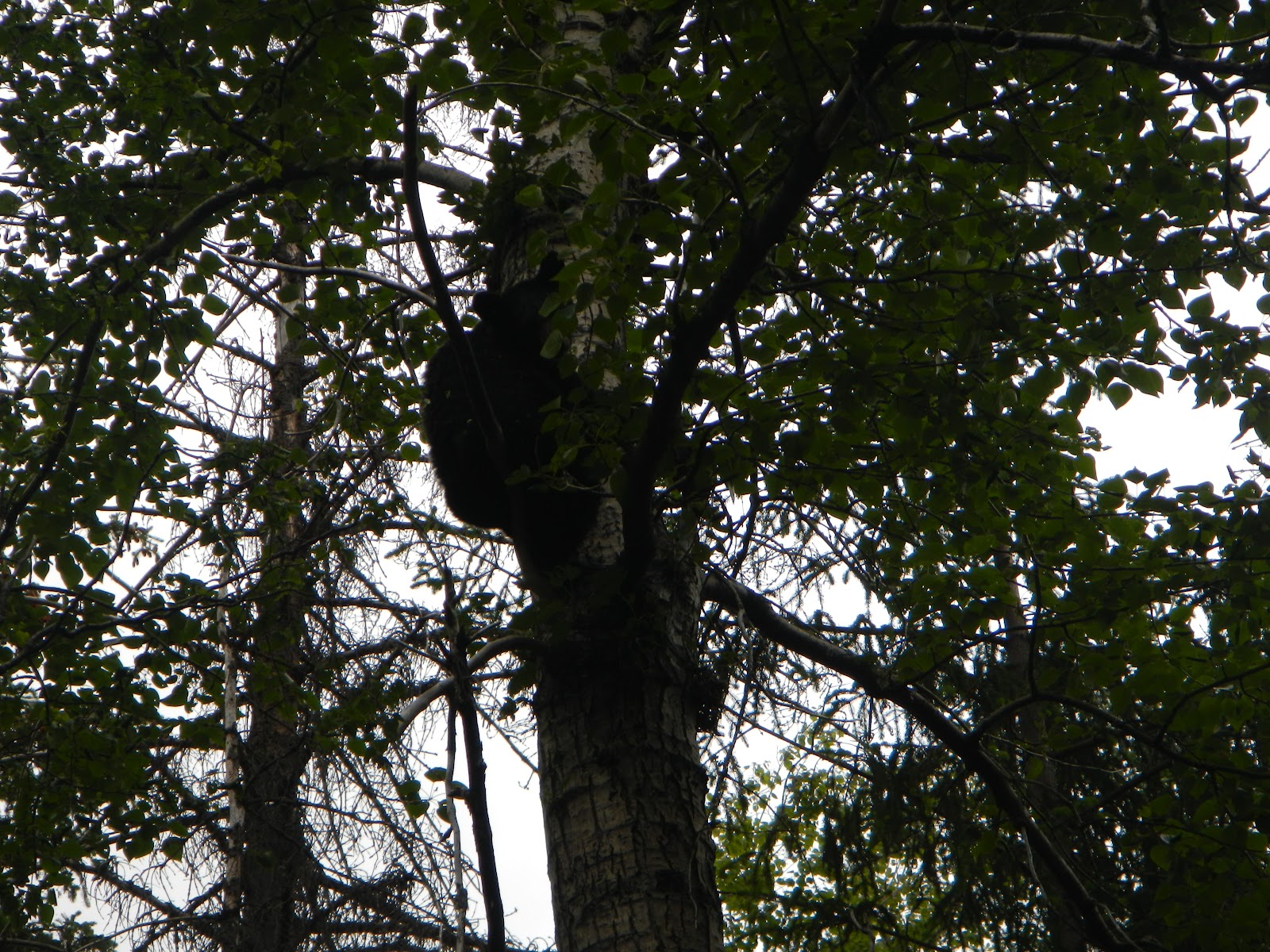
We came around the corner at one point with Canyon 50 yards ahead of me. I heard a russel in the leaves and then the distinct sounds of claws on a tree, what must only be a bear scampering up. Sure enough Canyon surprised the bear and within 2.5 seconds the bear was 40 feet up the nearest tree, in 3 second I had the bear spray out, in 4 seconds Canyon was back at my side and then on the leash.


In other news, rivers across the Kenai are experiencing super high flows. The Kenai is at 10,300 cfs, nearly 4,000 above the average.


14 June 2012


03 June 2012
Updates from camp

We've got a bunch of new gear around camp. Eleven new Beulah rods including my 13'8" 8wt Spey, 8 new mirage reels, 2 Waterworks reels, a dozen new (rubber soled) boots, and a number of lines. (More on gear later)


We had a few trips on the Kasilof for Kings, and while the fishing was slow we brought a few to the boat, as well as a couple steelhead and dollies.

Ever spent the night in a yurt?

10 May 2012
Sunrise up North
There's little that is more excited than an approaching season. Some wait for ski season, some wait for beach season, and others for fishing season. In places like Colorado, New York, and California the action exists through the winter in a subdued version of its exuberant summertime self.
In Alaska, however, fishing is more volcanic - dormant for the majority of time and then absolutely explosive. Two weeks ago the action was imperceptible, dormant except for a few awakening twitches. Come summer, the Kenai and the rest of the frontier waters will be explosive with bent rods, gip and grins, combat zones, trophies, and fulfilled dreams. There are days when we can't empty the net fast enough, when we can fish any fly in the box and hook up, when I lose count before 8 am. This is the explosion. Its not daily, some days it's just smokey, but sometimes it's just on fire.

At Angle 45 we're getting ready for our season on the Kenai. Rods are coming down, lines, waders, and boots are being washed, reels re-spooled, boxes organized, flies tied, and boats dug out. Dormancy is melting off the shoulders of spring. After more than 11 feet of snow it's taking some work to dig out camp, but warm weather, many hands and a few cold drinks make for quick work.

We're ready to hit the water - excited to see some returning friends again and make some new ones on the river.
In Alaska, however, fishing is more volcanic - dormant for the majority of time and then absolutely explosive. Two weeks ago the action was imperceptible, dormant except for a few awakening twitches. Come summer, the Kenai and the rest of the frontier waters will be explosive with bent rods, gip and grins, combat zones, trophies, and fulfilled dreams. There are days when we can't empty the net fast enough, when we can fish any fly in the box and hook up, when I lose count before 8 am. This is the explosion. Its not daily, some days it's just smokey, but sometimes it's just on fire.

At Angle 45 we're getting ready for our season on the Kenai. Rods are coming down, lines, waders, and boots are being washed, reels re-spooled, boxes organized, flies tied, and boats dug out. Dormancy is melting off the shoulders of spring. After more than 11 feet of snow it's taking some work to dig out camp, but warm weather, many hands and a few cold drinks make for quick work.

We're ready to hit the water - excited to see some returning friends again and make some new ones on the river.
 |
| c. DFisher |
08 May 2012
The Academic Fisher
I cut my teeth on this water, fishing it after hours, after dark, blizzard conditions, throughout the year. South Park's like that - its own world you never want to leave. The grass is never greener on the other side when you're on the Dream Stream.
Thousands of people fish this segment every year, using the same gear, the same flies, the same techniques, targeting the same fish - but they don't catch them like Landon does.
Do you know you're home waters this well? We've all got work to do.
02 May 2012
Guest Post from Larry: Mousing For Trout
A few weeks ago Larry asked me if he could write a post for my blog - of course he can. Here you go:
Mousing for Trout
There is no denying that fish are aggressive predators much like a wolf or jungle cat. Proof can be seen in the reaction that a mouse pattern creates among hungry rainbow trouts. If you haven’t tested this rodent like lure it might be a good back-up plan for you the next time you are searching for a trophy fish.
Basic Appearance
Some of the mouse patterns available in the commercial market will actually have nose, whiskers and ears on top that really look like a rodent. However, the main appeal of the lure is the bulky body covered in hair along with a long tail. Since the fish will likely catch a glimpse of the lure from underneath or at a slight angle, the top of the pattern can vary a little bit and still be effective.
Movement of the Lure
Mice, as you know, have 4 legs. So they can jump, swim, crawl and skitter on just about any surface. Thus, moving the lure like a swimming, sputtering, jumping mice is the attraction that leads to big strikes. Imitating movements of a mouse will likely lead to some strong reactions from the trout that could leave you breathless and laughing at the same time!
Getting a Good Hook Set
Rainbows will often hit this lure in hopes of drowning it and then circling around in search for the lure. Therefore, it is important to be alert and watch the fish. If you see a huge mouth opening up to snatch the lure, the fish is likely trying to get it in a single pass. Otherwise, you may have to wait a second or two to give the fish a chance to actually get the lure in its mouth. Once you feel that familiar tug, sweep your rod hard to one side in order to really get a good hook set. Avoid setting the hook when you first see the fish take the lure. You will likely pull the mouse away too soon.
Places to Try Mousing
One of the best places to try your hand at the mouse pattern is during the month of August in Alaska. The spawn in on full force and fish are hungry for protein. If you are in Alaska at all during the summer months, a mouse pattern can produce a good bite.
But Alaska is not the only place to use these ingenious lures on beautiful rainbows. Any body of water that holds trout along with lemmings, mice and voles is a good spot to try. Yellowstone reported good results from mouse patterns in 2009 during a time when coyote numbers were down and the mice population was up. Penns Creek in Pennsylvania has boasted a trout of 24 inches caught with the rodent lure. And Steamboat, Colorado has good waters on the Yampa River that are perfect for landing a nice trout.
You can try your hand at tying a mouse pattern using readily available information on the internet or you can buy one from one of the big manufacturers. Either way, give it a try. It is a new way of fishing and could lead to a new trophy for you.

Larry Chandler is an outdoor writer for upstate New York fishing guide.
Subscribe to:
Posts (Atom)